Jiu-Jitsu gives you a rare mix of calm focus and real-world capability, built one round at a time.
Brazilian Jiu-Jitsu keeps growing for a reason: it works, it’s challenging, and it changes how you carry yourself. Participation is rising around 18 percent each year, and the global market is projected to hit 2.5 billion dollars by 2033, which tells us something simple: more people want training that feels practical and measurable, not random.
If you’re looking for Jiu-Jitsu in Hazlet, NJ, you probably want more than “a workout.” You want skills you can actually use, plus strength, conditioning, and a clearer head at the end of the day. That’s exactly how we structure our training: honest technique, safe intensity, and a plan you can stick with.
Whether you’re brand new, getting back into training, or already rolling and want better results, our goal is to help you build repeatable fundamentals that hold up under pressure. That includes the physical side, but it also includes focus, composure, and decision-making, which is the part most people don’t realize they’re missing until they feel it.
Why Jiu-Jitsu works when stress is real
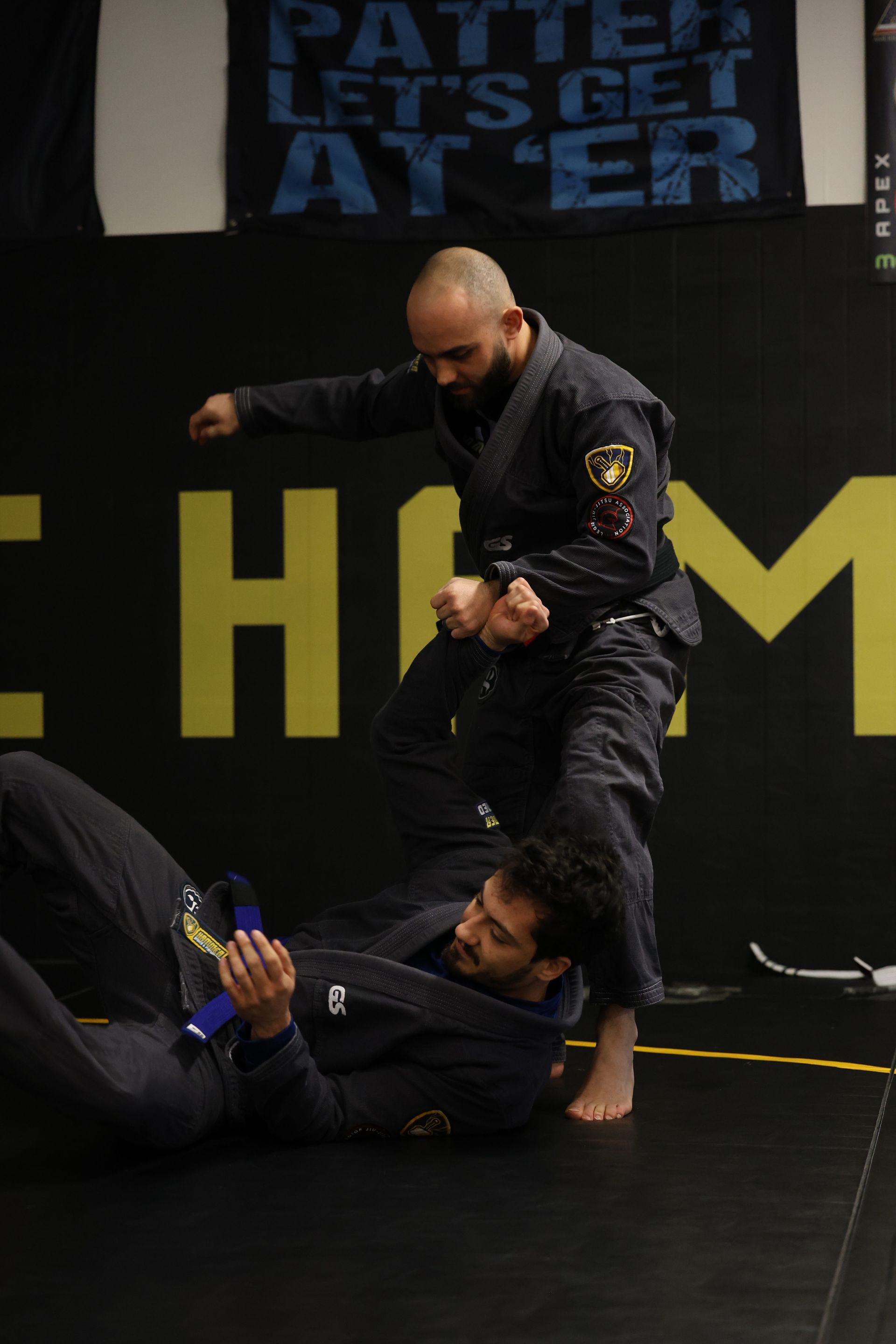
Jiu-Jitsu isn’t theory. You feel immediately what works and what doesn’t because your partner gives real resistance. That feedback loop is why progress can be so fast when you train consistently. Instead of guessing, you’re learning how to solve problems with your body, your timing, and your positioning.
That problem-solving carries over. You learn to breathe through tough moments, keep your posture when you’re uncomfortable, and choose the next best step instead of panicking. A lot of adults come in for fitness or self-defense, then stay because they notice the mental shift: better patience, better stress tolerance, and better confidence in everyday situations.
Research and surveys in the BJJ community back this up. In adult participants, 87.5 percent report reduced anxiety and 87.6 percent report improved confidence, with many also describing a strong community connection. Those numbers aren’t magic, but they match what we see: consistent training gives your brain somewhere to put stress, and you walk out feeling more steady.
What you’ll build here: focus, strength, and usable technique
We keep the focus on transferable skills. That means we emphasize positions and concepts that show up in real sparring, not just moves that look cool on video. You’ll learn how to control distance, how to protect yourself, and how to move efficiently so you don’t gas out after two minutes.
Jiu-Jitsu also builds a specific kind of strength: grip endurance, hip control, and full-body coordination under tension. It’s not bodybuilding strength, but it makes you feel athletic in a way that’s hard to fake. When you pair that with better cardio and a consistent schedule, your body composition tends to follow, especially with the current 2025 push toward muscle building and performance-based fitness.
And yes, you’ll learn submissions, but we treat them as the final step in a chain. Control first, then position, then finish. That approach helps beginners feel safer, and it helps experienced students stop relying on “scrambles” and start getting cleaner results.
Beginner-friendly training without the awkwardness
Starting can feel intimidating, mostly because you don’t know what the room expects from you. We make that simple: show up ready to learn, keep good hygiene, and don’t worry about “winning” early. Beginners improve fastest when they stay relaxed and collect reps, not when they try to prove something in their first month.
We also coach you on pacing. It’s normal to go too hard at first. Most new students do. We’d rather you train three months in a row than train like a maniac for two weeks and disappear. Progress in BJJ Training Hazlet, NJ is all about consistency.
If you’re concerned about being “out of shape,” you’re not alone. You don’t need to get fit before you start. Training is how you get fit. We scale intensity, pair people responsibly, and keep your learning moving forward without throwing you into chaos.
How often should you train to improve?
If you want noticeable improvement, 3 to 4 sessions per week is the sweet spot for most adults. That frequency gives you enough exposure to retain techniques, develop timing, and build conditioning without feeling like your whole life is training.
That said, 1 to 2 sessions per week still works. It’s just slower. You’ll learn, you’ll sweat, and you’ll get better, but you may need more weeks of repetition before things feel automatic. If you’re balancing work, family, and everything else, we help you choose a realistic rhythm so you can keep going.
No-Gi trends and why they matter for your real skill set
One of the biggest 2025 to 2026 trends is the rise of No-Gi grappling and submission-only formats, with more attention on standing exchanges and takedowns. Even if competition isn’t your goal, that shift is useful for everyday training because it pushes you to develop movement, posture, and control without relying on grips.
In our approach, we make sure your stand-up and entries aren’t an afterthought. You’ll learn how to close distance, how to stay balanced, and how to land in positions where you can work. That’s a big part of building “real skills” instead of just collecting techniques.
No-Gi also tends to reward conditioning and pace management. You learn to choose when to explode and when to settle. That’s a skill, not a personality trait, and it’s trainable.
The leg lock revolution, taught with structure and safety
Leg locks are evolving fast. More athletes are specializing heavily, and you’ll see entire game plans built around leg entanglements, entries, and counters. For the average student, that can feel like a confusing world of new names and sudden taps.
We teach leg attacks with a clear framework: position, control, finishing mechanics, and defense. We also coach smart training habits so you can develop skill without unnecessary risk. The goal is for you to understand what’s happening, recognize danger early, and respond correctly, not just “hope your knee survives.”
This is also where good coaching matters. Leg locks done poorly are chaos. Leg locks done correctly are technical, controlled, and surprisingly precise.
Hybrid training: why we blend skills for a stronger base
Another major trend is hybrid training that blends BJJ with wrestling, judo, striking, and practical self-defense concepts. We like hybrid thinking because real performance doesn’t happen in neat categories. You need takedown awareness, clinch understanding, and the ability to move from standing to ground without losing position.
That doesn’t mean you’re doing a little of everything with no direction. We use hybrid elements to support your Jiu-Jitsu, not distract from it. For example, wrestling concepts help your top pressure and takedowns. Judo concepts help your balance and off-balancing. Conditioning work supports your ability to stay technical late in rounds.
If your goal includes MMA readiness, hybrid development is even more important, because Jiu-Jitsu is a foundation of MMA, but it’s not the whole picture. Our job is to connect the dots in a way that’s understandable and progressive.
Tech integration without losing the human side of training
Wearables and performance tracking are becoming normal: Whoop, Oura Ring, heart rate tracking, and even AI-based technique review. We’re big on using tools to support the basics: recovery, sleep quality, stress load, and training volume. Most plateaus aren’t mysterious. They’re often recovery problems.
When you track the right things, you make better choices. Maybe you push hard on a day you’re ready, and you go lighter when your body is clearly not recovered. That kind of awareness keeps you training for years instead of burning out.
We also keep a simple truth in front of you: tech is helpful, but it won’t replace mat time. Nothing replaces rounds, coaching, and the feel of timing against another person.
Self-defense that matches real life in Hazlet
People in Hazlet want training that feels practical. Our community is tight-knit, and most students aren’t looking for trouble. You want to feel safer, not more aggressive. Jiu-Jitsu is excellent for that because it teaches control. You learn how to manage distance, establish grips and frames, and neutralize someone without needing to “win a fight” in a dramatic way.
We also build awareness: how to keep your base when someone crowds you, how to get up safely, and how to avoid bad positions. If you never need to use it outside the gym, that’s a win. But if you do, you’ll be glad your training wasn’t just cardio with fancy names.
Women’s training and a culture that supports progress
Women’s participation in martial arts is rising, and BJJ is consistently one of the most popular choices. In our training environment, we focus on technical development, respectful partner work, and coaching that doesn’t talk down to you. The goal is skill and confidence built through practice, not hype.
A lot of women come in for self-defense and stay for the strength, the community, and the mental clarity that shows up after hard rounds. We keep that experience welcoming for beginners and challenging for experienced students, because both matter.
If you’re nervous about contact or sparring, we get it. We can start you with structured drilling, positional rounds, and controlled intensity so you build comfort step by step.
What a typical class feels like
Most classes follow a rhythm that keeps learning organized and safe. You’ll warm up with movements that support grappling, then build technique in layers, and then apply it in live rounds with coaching and boundaries.
Here’s what you can expect in a typical session:
- A focused warm-up that builds mobility, balance, and grappling-specific conditioning
- Technique instruction with clear details on posture, frames, and leverage
- Partner drilling where we help you correct common mistakes early
- Positional sparring that isolates one situation so you learn faster
- Live rolling with guidance on pace, safety, and smart decision-making
The vibe is serious but not tense. People work hard, but we keep it respectful. You should leave feeling like you learned something specific, not like you survived a random storm.
How to get started without overthinking it
Starting is easier when you treat it like a process, not a personality test. You don’t need perfect gear or a perfect plan. You need a first class, then a second, then enough repetition that the basics start to click.
A simple way to begin:
1. Check the website for the class schedule and pick two days you can reliably commit to.
2. Show up a little early so we can get you oriented and answer quick questions.
3. Train at a controlled pace, focusing on posture, breathing, and learning, not “winning.”
4. Ask us what to practice between classes so you don’t feel lost.
5. After a few weeks, adjust your training frequency to match your recovery and goals.
That’s it. Small steps, repeated, turn into real skill faster than most people expect.
Take the Next Step
Building skill in Jiu-Jitsu is about stacking good rounds, good reps, and good habits until confidence becomes normal for you. When you train consistently, you’ll notice the changes in your focus, your conditioning, and the way you handle pressure, on the mat and off it.
At Hammer Sports and Performance, we keep our coaching practical, our training progressive, and our culture centered on real improvement for real people here in Hazlet, NJ, whether your goal is fitness, self-defense, competition, or simply doing something challenging that actually sticks.
Develop control, timing, and discipline through Adult Jiu-Jitsu at Hammer Sports and Performance.
