Jiu-Jitsu turns uncertainty into a plan you can practice, pressure-test, and rely on.
Jiu-Jitsu has grown from a niche self-defense system into one of the fastest-growing martial arts in the U.S., and we see the reason every day on our mats. Adults want something practical, not performative, and they want training that builds real confidence without requiring a fighter’s lifestyle. If you live in Hazlet or nearby in Monmouth County, that demand makes a lot of sense.
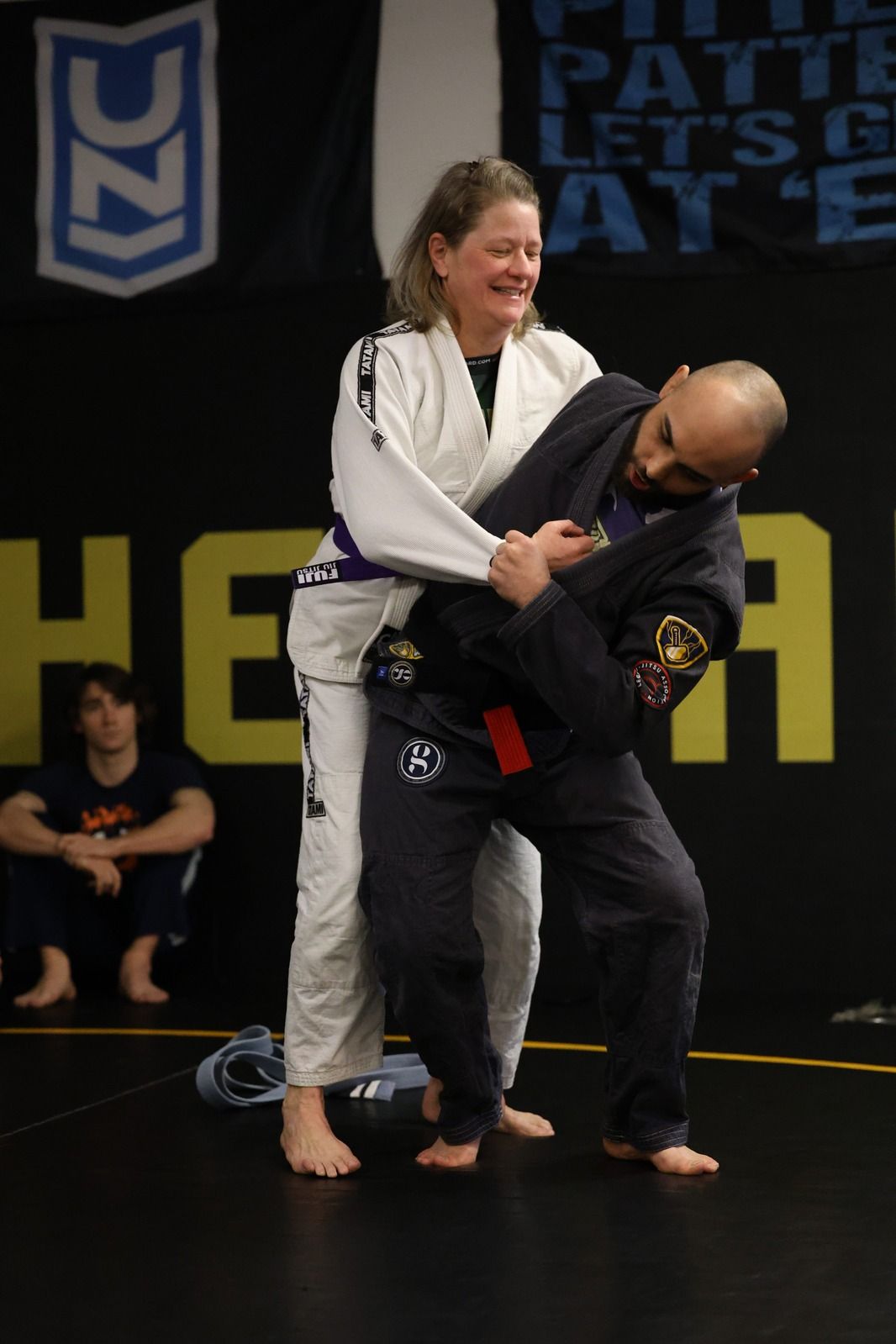
Our approach keeps the focus on what actually helps you in close quarters: control, escapes, balance, leverage, and decision-making under pressure. That matters because real-life situations tend to get crowded fast, and the skills you develop in training are the skills you keep when adrenaline shows up. Jiu-Jitsu is also refreshingly honest: you learn what works by testing it against resistance, safely, with coaching and structure.
There’s another layer people don’t always expect. A large majority of practitioners report better problem-solving from training, and we’ve watched that play out in small ways that add up, like staying calm in tough spots, sticking to a plan, and recovering quickly after mistakes. You show up to train your body, and your brain quietly gets better at handling stress.
Why Jiu-Jitsu works for self-defense in Hazlet
Self-defense is not about collecting techniques, it’s about building reliable responses. Jiu-Jitsu gives you a framework for dealing with the most common problem in real confrontations: someone closes distance and tries to grab, tackle, or overwhelm you. Instead of relying on being stronger or faster, we teach you how to use leverage and positioning to slow chaos down.
In practical terms, you learn how to manage space, create frames with your arms, protect your head, and prevent someone from controlling you. Once you can stop the worst-case positions, you can start moving toward safer ones. That sequence is what makes beginners improve faster than they expect.
Hazlet sits in a busy part of New Jersey where people commute, run errands, and live close to one another. That kind of day-to-day density is exactly where close-range skills matter most. We keep training grounded in real scenarios, but we also keep it measured. Nobody needs “street stories” to train effectively, just a clear curriculum and consistent practice.
The self-defense mindset: awareness, distance, and control
Before we talk technique, we teach mindset. Not in a dramatic way, just in a useful way. The goal is to make good decisions sooner, because the best self-defense win is the one you never have to fight for.
We build that mindset around three priorities:
• Awareness: noticing what’s off before it gets close
• Distance management: keeping space when possible and knowing what to do when it’s not
• Control: using position to reduce damage and regain options
Jiu-Jitsu shines in that third category. Once contact happens, you still have choices. You can stabilize, escape, stand up, or restrain, and we practice those transitions until they stop feeling like guesswork.
What you actually learn first in our fundamentals classes
A lot of adults hesitate because they imagine complicated moves and athletic flips. Real training starts simpler. We prioritize positions and escapes that show up constantly, and we repeat them enough that your body begins to understand the shapes.
In our beginner-friendly structure, you’ll spend time on:
• Base and posture so you stop getting tipped or folded
• Escapes from bottom positions, because that’s where new students often end up first
• Guard concepts, including how to control distance with your legs and hips
• Top pressure and pinning fundamentals that don’t rely on brute strength
• Standing up safely, because self-defense often means disengaging, not “winning”
This is where Adult Jiu-Jitsu in Hazlet NJ becomes less of an idea and more of a weekly routine. You learn, you practice, you drill, you try it live at an intensity that matches your level. That’s the secret sauce, if we’re being honest: structure plus consistency.
Gi vs no-gi: which Jiu-Jitsu should you start with?
People ask this early, and it’s a fair question. Gi training uses the traditional uniform, which adds grips and friction. No-gi training is done without the gi, usually with rash guards, and tends to be faster with more scrambling.
For beginners, we like the gi for building clean mechanics and patience. The gi slows things down just enough that you can feel what’s happening and make better choices. No-gi teaches you to manage speed, sweat, and movement, which also matters in real life.
If your schedule allows, doing both is ideal, and we help you bridge the gap so the skills transfer. The goal is not to pick a side. The goal is to get good at controlling positions and escaping bad ones, regardless of clothing.
How long it takes to feel confident (and what “proficient” really means)
Adults want a timeline, and we respect that. In Brazilian Jiu-Jitsu, a common benchmark is earning a blue belt in roughly 1 to 2 years when you train about three times per week. Some people get there faster, some slower, and that’s normal. Life happens. Work happens. Knees get cranky sometimes.
But confidence usually arrives earlier than rank. Many students feel noticeably safer and more capable within a few months because they’ve learned:
• How to stay calm while someone applies pressure
• How to escape common holds and pins
• How to protect themselves while moving to a better position
• How to stand back up without turning their back or panicking
We also keep expectations realistic. Jiu-Jitsu is a long game, and that’s part of why it works. You don’t “finish” it. You build layers.
Why adults stick with bjj training Hazlet NJ when other fitness plans fade
It’s hard to stay motivated with workouts that feel like chores. Jiu-Jitsu is different because you’re solving problems in real time. Each round is feedback, and you’re never bored for long, even on days when you’re tired.
There’s also community, but not the forced kind. You learn people’s names, you partner up, you help each other improve. Some days you’ll be the person who understands a detail and shares it. Other days you’ll be the one asking questions. That back-and-forth keeps adults engaged.
And from a fitness standpoint, it’s sneaky effective. You build strength, grip endurance, mobility, and conditioning without staring at a clock. You’ll still sweat, but it doesn’t feel like punishment.
Safety and injury prevention: how we keep training sustainable
We coach adults, not robots. Safety is built into how we teach, how we structure sparring, and how we scale intensity. The goal is progress you can maintain, especially if you’re balancing a job, family, and everything else.
Here’s what we emphasize to reduce risk:
• Controlled rounds with clear goals, not random intensity
• Tapping early and often, because that’s how you keep training tomorrow
• Technique-first coaching, especially for submissions and joint locks
• Mat awareness so partners don’t collide or fall awkwardly
• Smart warm-ups that prepare hips, shoulders, and neck for grappling movement
We also talk openly about pacing. If you’re new, it’s okay to take rounds off. Consistency beats hero days.
Jiu-Jitsu for women and smaller athletes: leverage levels the field
One of the biggest misconceptions is that grappling only favors bigger, stronger people. Strength helps, sure, but Jiu-Jitsu is built around leverage and angles, and that’s exactly why it can work so well for women and smaller adults.
We focus on:
• Framing and posture to prevent getting flattened
• Escapes that don’t require bench-press strength
• Positioning choices that reduce risk and keep your head protected
• Control tactics that let you manage someone’s movement
Women’s participation in the sport is rising nationwide, and we take that seriously by making sure training stays respectful, technically focused, and welcoming without making it a “thing.” You should be able to train hard and feel comfortable doing it.
The mental benefits: stress relief, focus, and better decision-making
A surprising number of people start for self-defense and stay for the mental reset. Training forces your attention into the present. If you’re thinking about emails while someone is trying to pass your guard, you’ll notice quickly. That’s not a flaw, it’s the lesson.
Over 75 percent of practitioners report improved problem-solving skills from training, and we see why. You’re constantly:
• Identifying patterns
• Testing solutions
• Adjusting under pressure
• Learning from mistakes without spiraling
For adults in Hazlet juggling commutes and responsibilities, that skill set carries over. You become harder to rattle, and that’s useful on and off the mats.
A simple plan to start adult training (without overthinking it)
If you’re interested but unsure how to begin, keep it simple. Progress comes from showing up and focusing on fundamentals longer than your ego wants to.
A practical start looks like this:
1. Pick two or three class days per week and protect them like appointments
2. Learn the core positions first, especially guard, side control, mount, and back control
3. Drill escapes repeatedly, because escaping is your first real “superpower”
4. Add light sparring when you’re ready, keeping intensity moderate and goals clear
5. Track small wins, like surviving longer, staying calmer, or escaping one position cleanly
This is also where gear questions come up. A gi is usually a solid first purchase, and a rash guard helps for no-gi work. If you’re not sure what to buy, we’ll guide you so you don’t waste money on the wrong stuff.
Ready to Begin
Building real self-defense skill takes more than motivation. It takes a plan, coaching, and a place where you can practice Jiu-Jitsu the right way, safely, week after week. That’s what we’ve built at Hammer Sports and Performance, right here for Hazlet locals who want practical confidence, better fitness, and a training routine that actually sticks.
Learn beyond the article and apply it in training by booking a free trial class at Hammer Sports and Performance.
