Adult Jiu-Jitsu is one of the few workouts that trains your body, your mind, and your stress response at the same time.
Adult Jiu-Jitsu has exploded in popularity for a reason: it fits real life. Worldwide, Brazilian Jiu-Jitsu now has millions of practitioners, and search interest has more than doubled since 2004, outpacing many traditional martial arts. Around Hazlet, that matters because most of us are balancing commutes, deadlines, family calendars, and the simple reality that energy is not unlimited after 6 pm.
We built our Adult Jiu-Jitsu program for exactly that lifestyle. You do not need to train every day to make meaningful progress, feel more capable, and get a training session that actually clears your head. If you can consistently show up one to two times per week, we can make that work and keep it sustainable.
This guide breaks down what Adult Jiu-Jitsu looks like for busy professionals in Hazlet, how to start without feeling overwhelmed, and how to train safely and steadily so you can keep showing up.
Why Adult Jiu-Jitsu works for busy professionals in Hazlet
Jiu-Jitsu rewards consistency more than intensity. That is good news when your schedule changes week to week. A focused class where you learn one position, drill it with purpose, and then test it in controlled sparring can be more productive than an unstructured hour at the gym where you are half watching emails between sets.
For professionals, the mental benefit is often the first thing you notice. Studies and surveys in the sport commonly report big gains in confidence and problem-solving after a year of training, and that tracks with what we see on the mats. Every round is a live puzzle: you are under pressure, you breathe, you make decisions, you adapt. It is oddly calming once you get used to it.
Hazlet also sits in a very commuter-heavy slice of New Jersey. People come in carrying that “go-go-go” tension. Adult Jiu-Jitsu gives your nervous system a different job for an hour. When class ends, a lot of that static is gone, and you can go back to work or home feeling like you did something real.
What you actually do in an Adult Jiu-Jitsu class
Most beginners worry they will walk into a room of experts and get thrown into chaos. Our approach is the opposite: structure first, intensity later.
A typical class includes a warm-up designed for grappling movement, technique instruction, drilling with a partner, and then positional training or sparring (also called rolling). The goal is to build skill through repetition, not to “win” practice. If you are new, we coach you on pacing, safe movement, and how to communicate with training partners.
You will learn how to:
• Stay balanced and safe on the ground
• Escape common pins and holds
• Control posture and distance with your legs and grips
• Apply submissions responsibly, especially chokes and joint locks
• Transition between positions without rushing
If you follow the bigger competitive trends, you will hear about wrestling influence increasing and finishes changing. Even if you never compete, that trend is useful for busy adults because it pushes training toward practical takedown awareness, strong top control, and cleaner fundamentals. In recent high-level events, chokes remain the most common submissions, while flashy leg-lock finishes have become less frequent. That is a reminder that basics still run the show.
Getting started when your schedule is packed
If you are a busy professional, the best plan is one you can keep. We would rather see you train twice per week for six months than crush a two-week burst and disappear.
Here is a simple, sustainable way to start Adult Jiu-Jitsu in Hazlet NJ without burning out:
1. Pick two “anchor days” you can usually protect on your calendar
2. Treat training like an appointment, not an option you negotiate with yourself
3. Focus on survival skills first: frames, escapes, posture, breathing
4. Add intensity slowly as your body adapts and your timing improves
5. Review one small concept after class so it sticks, even if it is just a note on your phone
That is it. No complicated spreadsheet. No perfection required. Just a plan that respects your life.
Gi vs no-gi for adults: which is better when time is limited
You will hear people debate gi and no-gi like it is a personality test. Realistically, both build strong grappling skills, and both can support your goals. The better choice is often the one that fits your comfort level and the class schedule you can attend consistently.
Gi training: slower pace, strong fundamentals
The gi adds grips on sleeves, collars, and pants, which slows things down and makes control more technical. Many adults like the gi because it gives you time to think and learn structure. It also teaches patience, which sounds boring until you are trying to escape side control and realize patience is a skill.
No-gi training: athletic, sweaty, and very practical
No-gi tends to be faster with more movement and more emphasis on underhooks, head position, and wrestling-style control. If you want a training style that feels closer to real-world grappling, no-gi is a great fit. It is also simple gear-wise: rash guard and shorts, done.
If you are unsure, we guide you toward the best entry point based on your experience, goals, and what you will realistically attend. Consistency is the multiplier.
Injury risk, prevention, and training smart after 30
A common concern for Adult Jiu-Jitsu is injury, especially for adults over 30 or anyone returning to fitness after a long gap. The truth is that injury risk exists, like any sport, but most preventable issues come from avoidable habits: going too hard too soon, refusing to tap, or treating every round like a tryout.
Data from research on BJJ injuries shows novices often get hurt in training more than competition, largely because beginners have less body awareness and less control. That is why we coach new students closely on safe movement and responsible intensity. You do not need to “prove toughness” in class. You need to be healthy enough to come back next week.
Practical ways we help you stay healthy
We build a culture where tapping is normal, pace is coached, and partners communicate. You can also protect yourself by doing a few simple things:
• Tap early to joint locks, especially armbars and shoulder attacks
• Avoid posting your hand awkwardly when you fall or get swept
• Breathe through pressure instead of thrashing to escape
• Tell your partner if you have a neck, back, or knee history
• Strength train moderately, because resilient muscles protect joints
If you have not trained in a while, your ego might feel ready before your tendons are. Your body will catch up, but it likes a gradual ramp.
How long it takes to get “good” and what progress looks like
People ask about black belt timelines, and averages often land around three to five years for a highly dedicated path, with many adults taking longer because, well, life. The more useful question is: when will you feel progress in daily training?
Most adults notice improvements in the first month, not in perfect technique, but in comfort. You learn how to move on the mat, how to keep yourself safe, and how to understand what is happening. Around three months, you start to recognize patterns. Around six months, you usually have a few “go-to” escapes and attacks you can hit on purpose, which feels amazing.
Confidence is a big part of this. Surveys often cite around 85 out of 100 practitioners reporting higher confidence after a year. That confidence is not loud. It is quieter than that. It is the feeling that you can handle pressure without panicking.
What busy professionals get out of training beyond fitness
Adult Jiu-Jitsu is conditioning, yes, but the deeper value is how it changes your behavior under stress. The mat gives you a controlled place to practice staying calm in uncomfortable positions, which carries over into work, presentations, conflict, and even parenting.
Professionals also tend to like how measurable the sport is. You can track progress by position: Can you escape mount more often? Can you hold side control longer? Can you finish a choke cleanly without cranking? These are real benchmarks.
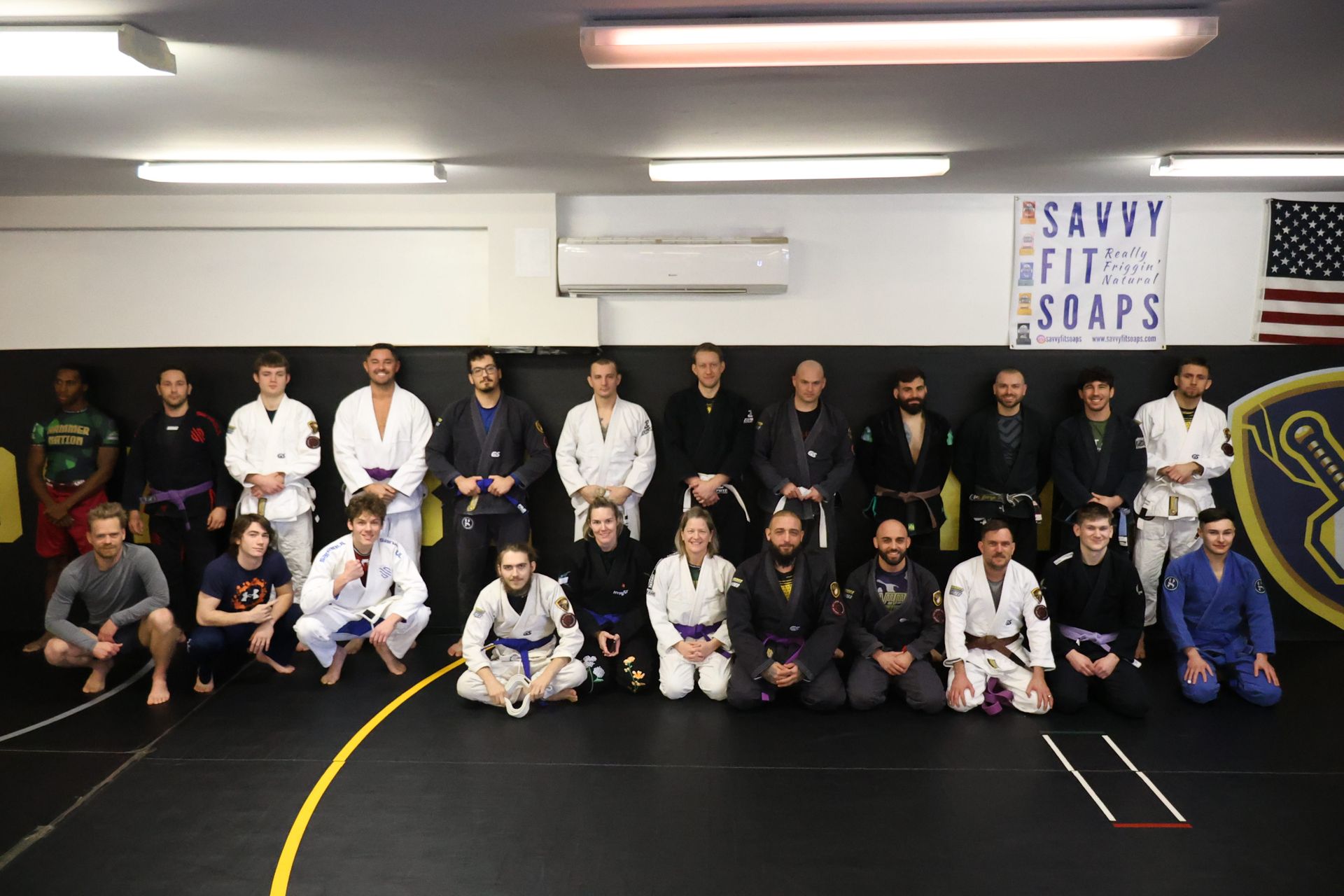
And there is a social side that feels refreshingly normal. You show up, train with people who also have jobs and responsibilities, laugh a bit between rounds, and then go back to your day. It is community without a big production.
What to bring, what to wear, and how to prepare for day one
Preparation reduces anxiety. If you know what to expect, your first class feels straightforward.
For gi classes, you will need a gi eventually, and most adults spend somewhere in the 50 to 150 range depending on brand. For no-gi, a rash guard and athletic shorts are enough. Bring water, show up a little early, and plan to leave your jewelry at home.
A small tip that helps: eat lightly two to three hours before class. Grappling is close contact and very core-heavy. You will thank yourself later.
If you are searching for bjj training Hazlet NJ and you are worried about being “out of shape,” do not overthink it. We scale intensity, pair you appropriately, and coach you through the learning curve. Everybody starts somewhere, and the first step is just getting on the mat.
Ready to Begin
Building skill in Adult Jiu-Jitsu is not about having endless free time. It is about choosing a routine you can repeat, learning fundamentals that keep you safe, and training in an environment where progress is measured in months and years, not in a single hard class.
That is what we focus on every day at Hammer Sports and Performance: practical coaching, a professional-friendly pace, and a program that makes Adult Jiu-Jitsu in Hazlet NJ realistic even when your calendar is tight.
Experience structured Adult Jiu-Jitsu training at Hammer Sports and Performance.
