BJJ is one of the few workouts where your whole body, your brain, and your confidence improve at the same time.
If you’ve ever felt stuck choosing between strength training, cardio, mobility work, and something that keeps you motivated, bjj training has a way of solving that problem in one place. It’s physical, yes, but it’s also skill-based, which means you’re not just counting reps and watching the clock. You’re learning how to move better, breathe better, and stay calm while working hard.
In our Hazlet facility, we see people come in with different goals, backgrounds, and ages, and we build the program so you can train in a way that makes sense for your body today. Some students want a real fitness outlet that doesn’t feel repetitive. Others want a challenging hobby that keeps them sharp. A lot of adults simply want a training routine they can stick with, because consistency is the thing that changes everything.
This guide breaks down why bjj training Hazlet NJ residents choose can be such a complete workout, what “full-body” actually means in Jiu-Jitsu, and how we keep training approachable for beginners while still making it challenging for experienced students.
What Makes BJJ Training a True Full-Body Workout
Calling something “full-body” gets thrown around a lot. In Brazilian Jiu-Jitsu, it’s not a marketing phrase, it’s just the reality of the movements. You’re pushing, pulling, framing, posting, bridging, rotating, and stabilizing, often in combinations that don’t show up in a typical gym routine.
The best part is that you’re not doing random motions. Every movement has a purpose: maintain position, improve position, finish a submission, or escape safely. That purpose is what keeps you engaged, and engagement is a sneaky driver of results because it helps you show up again next week.
From a training standpoint, a typical class includes technique practice, positional training, and (depending on the day and level) live rounds. Each part hits your body in a different way, which is why it feels like a complete system instead of “just cardio” or “just strength.”
Strength You Can Use: How Grappling Builds Real-World Power
You don’t need to be strong to start Jiu-Jitsu, but you will get stronger if you train consistently. And it’s a specific kind of strength: the ability to create pressure, hold posture, control your hips, and keep your base when someone is actively trying to off-balance you.
A lot of the strength gains come from isometric work, meaning you’re generating force without always moving much. Think of holding someone in your guard, keeping a tight pin, or maintaining a grip while you adjust your angle. Those efforts build strong connective tissue, stronger trunk stability, and better control through your shoulders and hips.
We also coach you to use technique so you’re not muscling everything. That matters at every age, but especially if you’re training into your 30s, 40s, 50s, and beyond. When you rely on clean mechanics, you can train hard without feeling like you’re grinding your joints into dust.
The “Hidden” Strength Benefits Most People Notice First
Students often tell us they feel stronger in everyday life before they see it in the mirror. Common early wins include:
- Better posture because your upper back and core have to stay engaged during control positions
- Stronger grip endurance from consistent hand fighting and controlled holds
- More stable knees and hips from learning base, balance, and pressure management
- Improved shoulder control as you learn frames, underhooks, and safe ranges of motion
- A core that works in all directions, not just “front abs” during crunch-style movements
Cardio Without the Treadmill Feel: Why BJJ Hits Your Conditioning Differently
Conditioning in bjj training is different because it’s not steady-state. You’ll have bursts of effort, moments of control, and times where the goal is to slow things down and breathe. That variability trains your heart and lungs in a way that transfers well to real-life movement.
In live rounds, you’re learning to manage energy. If you go 100 percent all the time, you gas out. So you start to understand pacing, when to explode, when to settle, and how to recover while still working. That’s a skill, and it’s also a conditioning upgrade.
We structure classes to build fitness progressively. You’ll drill movements with intention, then apply them in controlled positions, then put it together in sparring when you’re ready. Over time, you’ll notice you can do more work with less panic breathing, and that’s a big deal for long-term training.
Mobility and Flexibility: Movement You Actually Practice Under Control
Flexibility matters in Jiu-Jitsu, but mobility matters more. Mobility is the ability to move through ranges of motion with control, and bjj training naturally develops that in your hips, spine, ankles, and shoulders.
You’ll use hip escapes, bridges, technical stand-ups, and rotational movements that challenge stiffness in a practical way. The goal isn’t to become a gymnast. The goal is to be hard to pin, hard to off-balance, and able to move safely on the ground.
We also emphasize safe movement patterns. If something doesn’t work for your body right now, we scale it, adjust it, and build it over time. That’s how adults keep progressing without feeling beat up.
Core Training That Doesn’t Feel Like Core Training
Most people think core work means sit-ups. In Jiu-Jitsu, your core is constantly active, but it’s doing what the core is supposed to do: transferring force between your hips and upper body, stabilizing your spine, and helping you generate movement off the floor.
Even basic positions require core engagement:
- Guard retention asks you to control distance with your hips and frames
- Escapes require timed bridging and hip movement
- Top control demands posture, pressure, and balance
- Submissions often depend on angle changes driven by your trunk
The result is a strong, functional midsection that supports your back and helps your overall athletic movement, even if you never do a single plank outside of class.
Why BJJ Training Works for Kids, Teens, Adults, and Older Beginners
A big reason bjj training is accessible across ages is that it’s scalable. We can adjust pace, intensity, and training focus while keeping the same core skill development. The art itself rewards timing, leverage, and decision-making, not just speed or raw power.
For teens and young adults, training can be an athletic outlet that builds discipline and body awareness. For adults, it often becomes the most consistent training habit they’ve ever had, because it’s engaging and social in a grounded way. For older beginners, it can be a smart way to maintain strength and mobility while learning something new that keeps the brain working.
We’re also honest about progress: you don’t need to train like a competitor to get real benefits. Training two to three times a week, with good coaching and smart intensity, is enough to change how you feel in your body.
What “Training Smart” Looks Like in Our Classes
We keep longevity in mind, especially for Adult Jiu-Jitsu in Hazlet NJ, by leaning on a few simple principles:
1. Learn the positions first, then add speed later
2. Tap early and often while you’re learning, it’s a skill, not a defeat
3. Choose training partners who help you improve, not “win practice”
4. Build consistency with a schedule you can actually maintain
5. Treat recovery like part of training, not an afterthought
The Mental Side: Stress Relief, Focus, and Confidence That Builds Quietly
People come for fitness, and they stay because the training changes how they handle pressure. Jiu-Jitsu puts you in challenging situations in a controlled environment, then teaches you how to problem-solve. That carries over.
During bjj training, you practice staying calm while uncomfortable. You learn to breathe, make small adjustments, and keep thinking. That can be surprisingly therapeutic after a long day, because your attention has to be in the room. There’s not much mental space left for your inbox.
Confidence shows up in a quieter way than most people expect. It’s not chest-thumping. It’s more like: you trust your body, you trust your decision-making, and you feel capable doing hard things again.
What to Expect From Your First Adult Class
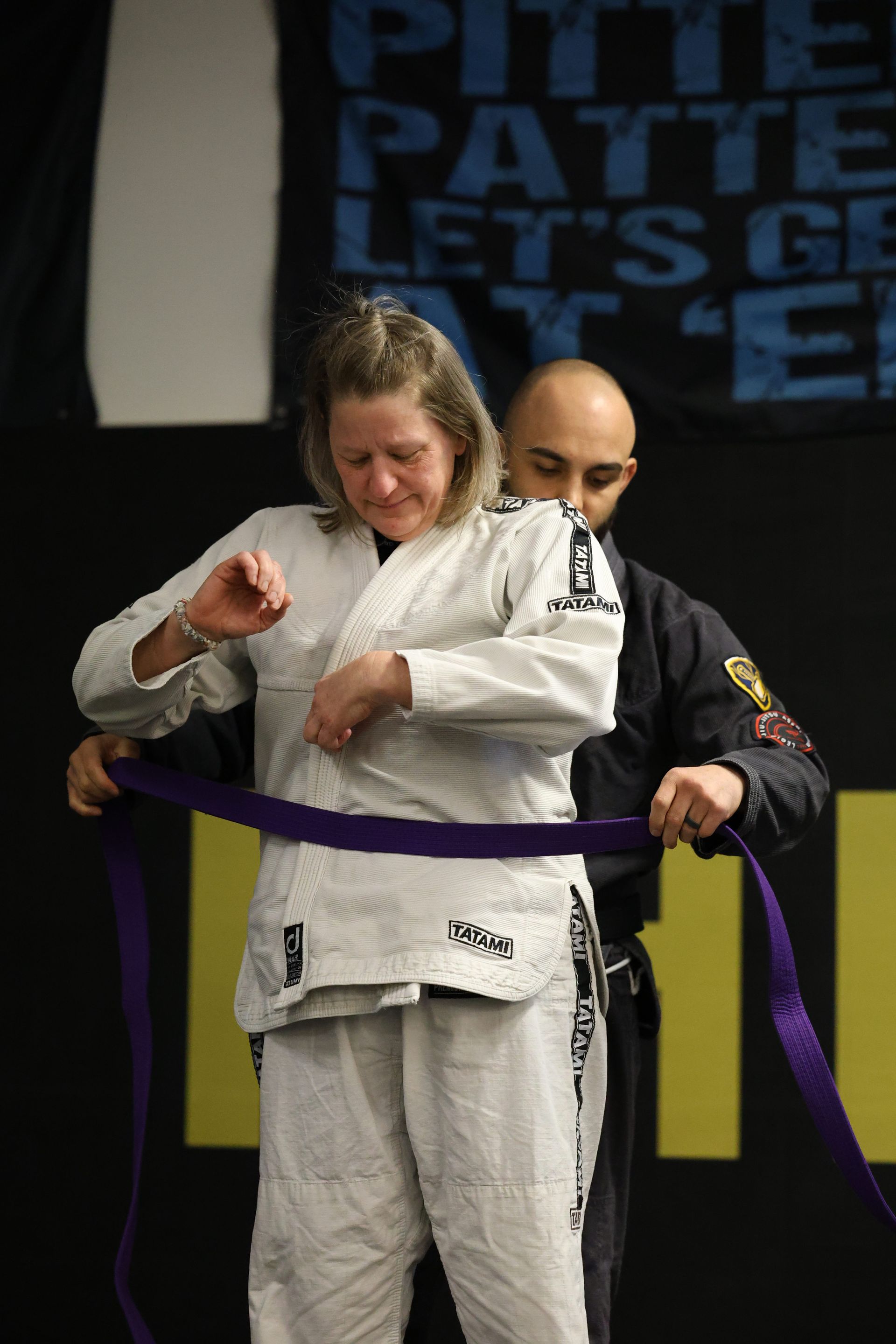
If you’re new, it helps to know what the first class actually feels like. You’ll probably be a little unsure at first, and that’s normal. We coach beginners step by step, and we keep the room welcoming and structured.
A typical first experience includes a warm-up that prepares your joints and breathing, technique instruction where we show the movement and the “why,” then partner drilling where you repeat it with guidance. Depending on the class format, you may also do positional rounds that keep things focused and beginner-friendly.
You don’t need to “get in shape first.” The training is how you get in shape. Start where you are, and let the process do its job.
Why BJJ Training in Hazlet NJ Fits Real Schedules (When the Program Is Built Right)
Consistency is the secret ingredient, and consistency depends on logistics. When a program has a clear class schedule, a beginner pathway, and coaching that helps you progress without feeling lost, people train more often. That’s how results happen.
We organize our program so you can plug in without needing to overthink it. You’ll know what to work on, how to measure improvement, and how to build your weekly routine. Some students train more, some train less, but the structure matters either way.
And because bjj training is skill-based, you’ll feel progress even before your body changes visually. You’ll move better, breathe better, and understand positions that used to feel chaotic.
Take the Next Step
If you want a workout that trains strength, conditioning, mobility, and mindset in one system, bjj training checks a lot of boxes, and it keeps getting better the longer you stick with it. It’s challenging, but it’s also surprisingly sustainable when you train with good structure and the right pace for your life.
That’s exactly what we aim to deliver at Hammer Sports and Performance in Hazlet, NJ: Adult Jiu-Jitsu that welcomes beginners, pushes experienced students, and supports long-term progress without making training feel like a punishment.
No experience required to get started. Sign up for a free trial class at Hammer Sports and Performance today.
